Szczepan Twardoch’s new novel, Waldkauz, will be published in Poland in October by Marginesy.
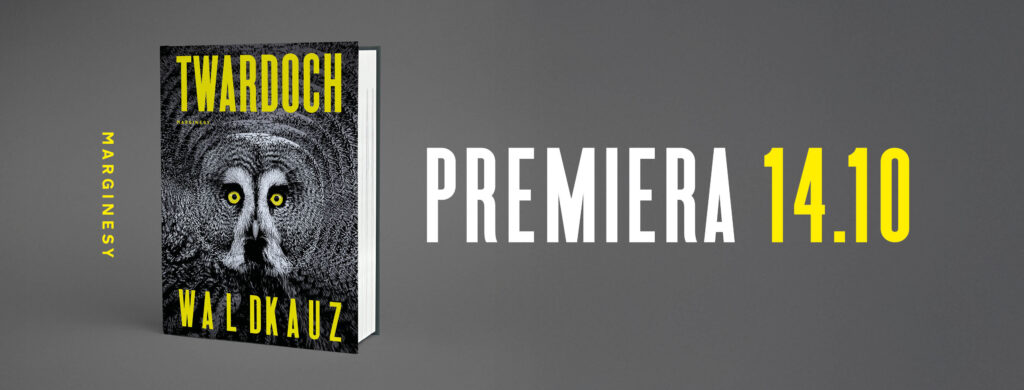
It is August 1920. Upper Silesia is in turmoil. Polish mixes with German, and the Silesian dialect with the English and French spoken by Allied soldiers. A distraught woman arrives at the office of Wilhelm Pisulla, an ex-wachmeister with the Gliwice criminal police and now a private investigator for the firm Detektiv-Lux. She is looking for her child. But she is not who she claims to be, nor is he an ordinary detective. For Pisulla has two souls, and the other one — the unbaptized one — has never howled so loudly. Only milk and cognac can calm her. Thanks to them, the raging voice, taking the form of a waldkauz (a tawny owl), sets out on a subtle hunt, only to return later to the man abandoned by his family. Pisulla’s son, Franz, went missing in the war, and his wife left, taking their younger son, Karliczek, with her. All that remained for Wilhelm was Wendelin Draga, his closest childhood friend and a man with too many secrets.
Waldkauz is a story full of mysteries, a story about male friendship and duties toward loved ones, about redemption, love, and what lurks in the darkness — separated from our world by only a thin, semi-permeable membrane. Wilhelm Pisulla understands the language of birds and speaks with drowners, but even he cannot find his son, who was devoured by the beast of war.
As the author states:
For me, this is both a novel of return and, at the same time, a different, new novel. A novel of return, because in it I return to the expansive narratives for which you’ve known me for well over a dozen years now, ever since “Morphine”. “Waldkauz” is also a return to Upper Silesia – specifically, to the year 1920 – which for me always means an intimate story, close to my flesh and blood. Yet it is also a new novel on my literary journey, for it launches a series and will certainly have a sequel, because the world you’ll find within its pages is not what you might expect – Wilhelm Pisulla, after all, understands the language of birds. And you can find there dragons, too.